

Ronda strategy: counting, hits and mind games
At first, Ronda feels like pure luck: you play the cards you're dealt and hope for the best. It isn't. With the right strategies and the habit of counting cards, you take most of the luck out of the game. Luck still plays a small part, in the hands you get, and that's what keeps Ronda fun once you get good: you win the games you should, and the cards can still surprise you.
This guide collects the habits that matter most. If you don't know the rules yet, read the full rules first; everything here builds on them.
1. Count the cards: the skill behind everything
Ronda uses 40 cards: four of each rank. Every one of them is played before the round ends, and the center never holds two cards of the same rank. That makes the game countable, and counting is the single biggest difference between a casual player and a strong one.
Almost every good decision in this guide comes from one question: how many cards of this rank are still out there?
- Leaving a card: if the other three of its rank are gone, nobody can hit it.
- Hitting: if you hold the last card of a rank, nobody can hit you back.
- Spotting: a player who played two cards of the same rank in one packet held a Ronda.
- The dealer's last turn: whether the dealer's last card can capture depends on how many of its rank are left.
You don't need a perfect memory. Start with the ranks in your hand and the ranks in the center:
- When cards are captured, note their ranks ("two 5s gone").
- Before you play, count how many of that rank you've seen.
- Recount at the start of each packet: your new hand changes the picture.
2. Every card you leave is a gift or a trap
If your card matches nothing, it stays in the center, and the next player can hit it with a card of the same rank. A first hit is worth 1 point, a second one on the same rank 5, a third 10.
So before you drop a card that captures nothing, ask: could the next player have that rank? If you can account for the other three, the card is safe. If you've seen none of them, you may be starting a hit sequence.
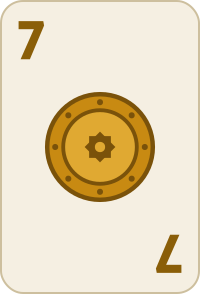
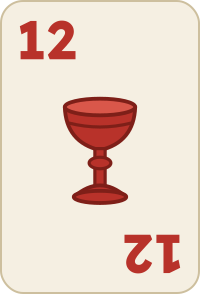
Look at what has been played: if two 12s are gone and you hold the third, only one 12 can still hit yours. That makes the 12 a better card to leave than a 3 nobody has seen yet.
What you leave also shapes the dealer's last turn, worth 5 points and the leftover cards. Read The dealer's last capture for how strong players plan the whole round around it.
3. When to hit, and when to hold back
A hit gives you 1 point, but it also opens a door: the next player can hit you back for 5, and the one after for 10. Whether to hit depends on what you know.
In the first packet, you know almost nothing. No cards have been seen, so any rank you hit may have two more copies around the table. A 1-point hit can quickly turn into 5 for the other team. Hold back, unless you have a reason to feel safe.
The best reason is a pair. If the card just played is a 10 and you hold two 10s, only one copy is unaccounted for, so the risk is low. (If you want that pair as a Ronda, declare it before you hit: once you play one of its cards, it's too late.)
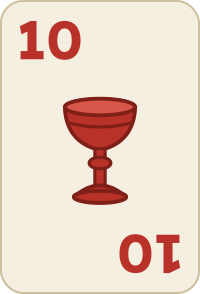
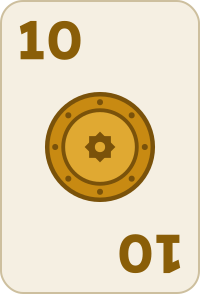
In later packets, let the count decide.
- If you hold the last card of the rank, hit without hesitating: nobody can answer.
- If copies are still out there, think twice, especially in the last packets, where the remaining cards are concentrated in fewer hands.
Safe hits worth knowing:
- The next player declared a Tringa. They hold three cards of one rank, and it can't be the rank you're hitting (you hold one, one was just played). Their other cards are few, so a hit back is unlikely.
- The last card of a packet. A hit stack is banked when the packet ends, so a hit on the last play of a packet can't be answered. The dealer plays last in every packet, which makes the dealer's late hits especially safe.
4. Declaring is a mind game
A Ronda adds 1 point and a Tringa 5 to the packet's pool, and the best combination takes the whole pool. That means a declaration that loses doesn't just score nothing: it adds a point for the other team. Other players see that you declared, not which rank, until the pool is paid. That's where the mind game starts.
A strong Ronda (10, 11 or 12): declare early. It probably wins the pool. Only the team that wins the pool may spot, so opponents who hide their own Ronda risk being caught.
A weak Ronda: wait. If nobody else declares, call it just before you play the first card of the pair: you still take the pool. If someone else declares first, your low Ronda would probably only feed their pool.
Someone declared first? You can stay quiet. Hiding your weak Ronda keeps that extra point out of their pool. Two warnings:
- Every card is played by the end of the packet, so your pair will be seen. An opponent who counts, and whose team won the pool, will spot it: that costs you the same point.
- If your team doesn't win the pool, you also give up your own right to spot.
Bluffing works too. Declaring a low Ronda early, with confidence, can scare opponents into keeping their better Ronda quiet: your Ronda then takes the pool, and your team may spot theirs.
The Tringa trap. With a Tringa, you can wait for others to declare their Rondas, then call your Tringa before playing its first card. Your Tringa beats them, and every Ronda they declared lands in your pool. The window is short: you must declare before you play a Tringa card, and in a 3-card packet your Tringa is your whole hand.
Online, mind the turn timer: when it runs out, the first card in your hand is played for you. If that card belongs to your pair, the declaration is gone. More on the rules in Declaring Ronda and Tringa.
5. Go for the Missa when it's cheap
Emptying the center with a capture gives your team 1 point, the Missa. When the center holds one or two cards and you can take them all, it's usually worth doing. Just remember what comes next: after a Missa the center is empty, so the next card played sits there alone, waiting to be hit. Keep a safe card for your following turn.
6. Watch the score near 39 and 40
Two limits change how you play the end of a game:
- At 39 points or more, your team can no longer declare Ronda or Tringa.
- At 40 points, your team can no longer score a Missa.
So a team stuck on 39 or 40 needs hits, the dealer bonus or card points to finish. If your team is still below 39, use this: you can still declare, and once the other team is at 39 or more, you can even spot its undeclared Ronda without winning the pool.
7. Card points decide close rounds
At the end of a round, each team counts its captured cards. The team with more cards scores its total minus 20 (24 cards = 4 points). Long runs and the leftovers that go to the last team to capture add up. In a tight game, a few extra cards in your pile can be the difference.
8. Practise against the bots, then play people
The fastest way to build these habits is to play many hands. Start against the Easy bot to learn the flow, move to Normal once you stop giving away hits, then take your counting online. Roonda's tutorial also walks you through a first hand with tips.
Next, learn exactly how hits climb in Ronda hits explained.