

The dealer's last capture in Ronda
The last card of a Ronda round is played by the dealer, and it's the most valuable card of the round. Strong players start preparing for it from the very first packet. This guide explains what is at stake and the counting method behind it.
What is at stake
On the dealer's very last turn of the round:
| The dealer's last card… | Result |
|---|---|
| captures with a 12 | dealer's team +5 |
| captures with a 1 | other team +5 |
| captures with a 2 to 11 | no bonus |
| captures nothing | other team +5 |
That's not all. After that turn, every card still in the center goes to the team that made the last capture. A dealer who captures on the last turn takes them all, and with them a big step toward the card points at the end of the round.
So a missed last capture is a swing of 5 points plus a pile of cards. A capture with a 12 is the best outcome of the round for the dealer's team.
A capture with a 1 still gives the other team 5, but it's better than capturing nothing: the other team gets those 5 either way, and the dealer at least keeps the leftovers.
Why the last capture can be planned
Three facts make the dealer's last turn predictable:
- Every card is played. By the dealer's last turn, all 40 cards have been played except that one.
- The dealer plays last in every packet, so every other card is already on the table.
- The center never holds two cards of the same rank. A card that matches the center always captures.
So the dealer's last card captures only if a card of its rank is waiting in the center. And whether one will be waiting can be counted.
The even-count rule
For a rank, count the cards not yet in anyone's pile: in hands, still to be dealt, or waiting in the center, the dealer's own card included.
- If that number is even (4 or 2), the dealer's card has an odd number of twins out there. They pair off as the round goes (one lands in the center, the next one captures it), and the last one is left waiting. The dealer captures it.
- If the number is odd (3 or 1), the twins pair off completely, and nothing is left for the dealer.
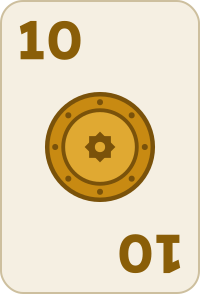
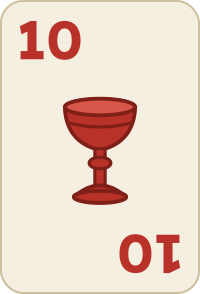
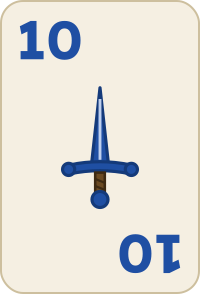
How the count breaks
Cards of a rank usually leave in pairs, but not always. Two things take an odd number of them, and they are what ruins a dealer's plan:
- Runs. A capture takes the whole run above the matched card. A 3 that captures a 3 with a 4 and a 5 next to it takes one 4 and one 5 on their own, and both ranks lose a single card.
- Double hits. A card left, hit, then hit again takes three cards of a rank in one sequence.
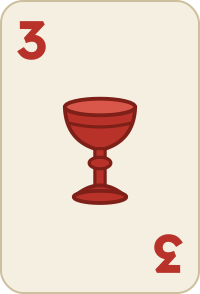
The perfect last card
The safest card to keep for the dealer's last turn:
- Has exactly two left: the dealer's and one more. With four left, the other three can go in one double-hit sequence and leave nothing.
- Has all four cards of the rank just below it gone, so no run can sweep its twin out of the center. (Below 10 comes 7: there are no 8s or 9s.)
- Is a 12 when possible, for the 5-point bonus.
When the choice is between a risky 12 and a safe card of another rank, keep the safe card: a capture with no bonus still avoids giving away 5 points and wins the leftovers.
The 1 has no rank below it, so no run can take it, but a capture with a 1 hands the other team 5 points. Keep it as a last resort.
When your team deals
Your goal is to keep ranks even, especially the 12s, so the dealer has good candidates at the end.
- Capture in pairs. Prefer captures that take one card of each rank, without long runs.
- Mind the order. Suppose the center holds a 10 and a 7, and you hold a 10 and a 7. Capture the 10 first, then the 7 on a later turn. Two 10s and two 7s are gone, both ranks stay even. Capture the 7 first, and its run takes the 10 too: one 10 gone alone, and the 10s become odd.
- Repair a broken rank. A run can also fix a count. Say the 10s are at three left, because a 7 earlier took a 10 by run, and two 7s are left. If the center holds a 7 and a 10 and you capture the 7, its run takes a single 10: the 7s are all gone and two 10s are left. That 10 is now a perfect last card.
In 2 vs 2 you can't see your partner's hand, so keep as many ranks even as you can, and protect the 12s first.
When the other team deals
Now you want the opposite: odd counts everywhere, and above all on the 12.
- Capture with runs that take single cards of the dealer's likely ranks.
- Break the 12s. When a 12 sits in the center, leaving an 11 next to it puts the 12 at risk: whoever captures the 11, by a match or a run from 10, takes a single 12 with it. Even if it costs a hit point, a broken 12 can save you 5.
- Watch the last packet. If you hold the twin of the dealer's likely last card, you have to play it, and it will wait in the center. Play it next to the rank just below it, so a run (yours or your partner's) can carry it away before the dealer's turn.
If the dealer misses, your team gets 5, and if you made the last capture, the leftovers too.
Quick recap
- The dealer's last turn: 12 = +5 for the dealer, 1 or no capture = +5 for the other team, and the last capturing team takes the center.
- Even number of a rank left (counting the dealer's card) = the dealer captures. Odd = nothing left.
- Runs and double hits change the count by an odd number.
- Best last card: two left, nothing below it, a 12 if it's safe.
To count well, start with Ronda strategy: counting, hits and mind games, or check the exact rule in the full rules.