

How Ronda scoring works, from Missa to 41
Ronda is a race to 41 points. Points come from six places, some small and frequent, some big and rare. Knowing them all is what turns a player who just matches cards into one who plays for the score.
This guide goes through every source of points, the limits near the end of a game, and then counts a full round from start to finish.
The six ways to score
| Source | Points | When it's paid |
|---|---|---|
| Missa (ميسا) | 1 | at the capture |
| Hits | 1, 5 or 10 | when the hit stack is banked |
| Ronda or Tringa pool | 1 per Ronda, 5 per Tringa | at the end of each packet |
| Spotting a hidden combo | +1 or +5 (wrong: −1 or −5) | at the end of each packet |
| Dealer's last capture | 5 | on the last turn of the round |
| Card points | your cards minus 20 | at the end of the round |
A score can never go below 0: a penalty bigger than your score just brings you to 0.
Missa: emptying the center
Missa (ميسا) is the most common point in Ronda. When your capture leaves the center empty, your team scores 1 point.
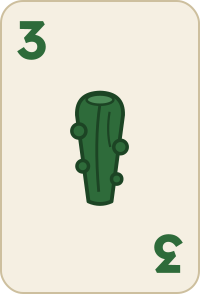
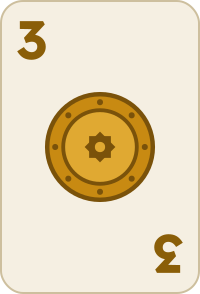
It doesn't matter how many cards you take. A run that sweeps the whole center counts the same:
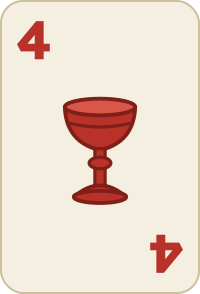
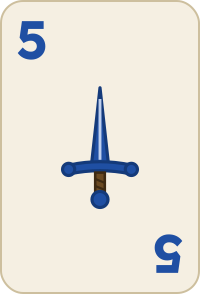
Two details matter:
- Missa inside a hit. If the capture is a hit, the Missa doesn't pay at once. It travels with the hit stack and goes to the team that banks it. If the opponent hits back, they take your Missa with the stack.
- Not at 40. A team with 40 points can't score a Missa. Otherwise a single sweep would win the game.
Hits: 1, 5 and 10
A hit is capturing the card the previous player just played, with the same rank. If the next player hits the same rank again, the hit climbs:
- first hit, ضريبة: 1 point,
- second hit, حبل: 5 points,
- third hit, جوج حبال: 10 points.
Only the last hit of a sequence scores, and only when the stack is banked: when the next player plays another rank, on the third hit, or at the end of the packet. A hit at the right moment is worth more than ten Missas, which is why it gets its own guide: Ronda hits explained.
Ronda and Tringa: the packet pool
Holding two cards of the same rank is a Ronda, three is a Tringa. You only score them if you declare them before playing any of those cards.
At the end of each packet, every declaration goes into one pool:
- each Ronda adds 1 point,
- each Tringa adds 5 points.
The best combination takes the whole pool. A Tringa beats a Ronda; between two Rondas the higher rank wins, between two Tringas the lower rank wins. If one player declares a Ronda and an opponent a Tringa, the Tringa's team takes 6 points.
Spotting
The team that won the pool may then spot an opponent who held a Ronda or Tringa without declaring it. A correct spot earns 1 point for a Ronda or 5 for a Tringa. A wrong one costs the same. All the details, including ties, are in Declaring Ronda and Tringa.
The dealer's last capture: 5 points
The dealer plays last, and the dealer's very last turn of the round is special:
| Dealer's last turn | Who scores 5 |
|---|---|
| captures with a 12 | the dealer's team |
| captures with a 1 | the other team |
| captures with 2 to 11 | nobody |
| doesn't capture | the other team |
A hit counts as a capture here too. Five points is a lot near the end of a game, so the dealer often plans this last turn packets in advance. More in The dealer's last capture.
Card points: counting the piles
After the dealer's last turn, any cards still in the center go to the team that made the last capture. Then each team counts its pile.
The deck has 40 cards, so 20 is an even split. The team with more than 20 scores the difference:
| Cards in your pile | Card points |
|---|---|
| 20 | 0 (nobody) |
| 22 | 2 |
| 24 | 4 |
| 28 | 8 |
Card points are where steady play pays off. Every capture, even a dull one, adds to the pile, and a round with no big moments can still be won 6 to 0 on the count.
The end of the game: 39, 40 and 41
The first team to reach 41 or more wins, and the game stops at that moment, even in the middle of a packet.
Close to the line, three limits change how you play:
- At 39 or more, your team can't declare a Ronda or Tringa. The other team, if it's below 39, may spot your hidden combinations even without winning the pool.
- At 40, your team can't score a Missa. You need a hit, the dealer bonus or card points to finish.
- Both teams at 39 or more: no Ronda, Tringa or spot counts for anyone.
So a team at 40 has to win with something bigger than a Missa, and the team behind can still catch up with a lucky hit.
A full round, counted
Here is a 2 vs 2 round, one packet at a time. "Us" is the dealer's team.
Packet 1. We take the last card in the center: Missa, Us +1. Later one of us plays a 5, they hit it, and nobody hits back: Them +1.
Packet 2. We declare a Ronda of 6s, they declare a Ronda of 3s. The pool is 2 points, and the higher Ronda wins: Us +2. Then they set a trap with a pair of 10s and make a double hit: Them +5.
Packet 3. They sweep the center with a run: Missa, Them +1. Our dealer keeps a 12 for the very last turn and captures with it: Us +5.
End of round. We captured last, so the two cards left in the center are ours. We count 23 cards: Us +3.
| Source | Us | Them |
|---|---|---|
| Missa | 1 | 1 |
| Hits | 0 | 6 |
| Ronda pool | 2 | 0 |
| Dealer's 12 | 5 | 0 |
| Card points (23) | 3 | 0 |
| Round total | 11 | 7 |
They made the biggest single play (the double hit), but we won the round on small, steady points and one well-kept 12.
Quick recap
- Race to 41; the game ends the moment a team gets there.
- Missa = 1 point for emptying the center (not at 40; it travels with a hit).
- Hits pay 1, 5 or 10, only for the last hit of a sequence.
- The best Ronda or Tringa takes the packet's whole pool; its team may then spot.
- The dealer's last turn: a 12 pays the dealer's team 5, a 1 or no capture pays the other team 5.
- Card points = your cards minus 20.
Ready to count your own points? Play Ronda online, or read the full rules for every detail.