
The Spanish deck in Ronda: suits, ranks and the 40 cards
If you grew up with hearts and spades, a Ronda table can look strange: coins, cups, swords, clubs, and no 8 or 9 anywhere. That's the Spanish deck (baraja española), and in Morocco it's simply the deck everyone plays with.
This guide explains how to read it, why Ronda uses 40 cards, and which cards matter most once the game starts.
The four suits
The Spanish deck has four suits, and each one is drawn as a real object:
| Suit | Spanish name | Looks like |
|---|---|---|
| Coins | oros | gold coins |
| Cups | copas | goblets |
| Swords | espadas | straight swords |
| Clubs | bastos | wooden clubs, like cudgels |
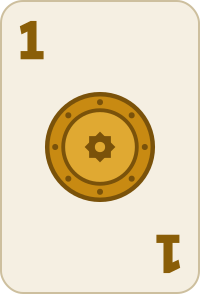
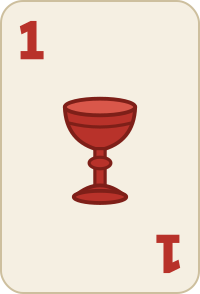
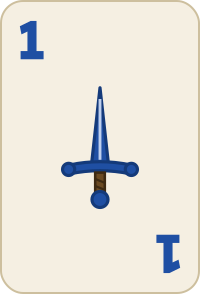
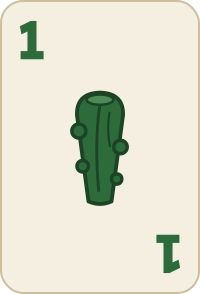
Here's the good news for beginners: in Ronda, suits don't matter. A 7 of coins captures a 7 of cups, and a hit only needs the same rank. No suit beats another and none scores extra. Suits only help you tell the four cards of a rank apart.
The ten ranks
Each suit has ten cards: 1 to 7, then 10, 11 and 12. There are no 8s or 9s.
The last three are the picture cards:
| Number | Spanish name | What it shows | Close to the French deck's |
|---|---|---|---|
| 10 | sota | a page, standing | jack |
| 11 | caballo | a rider on a horse | queen |
| 12 | rey | a king | king |
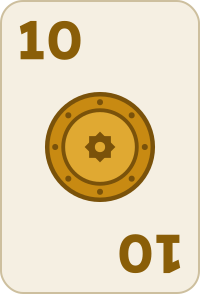
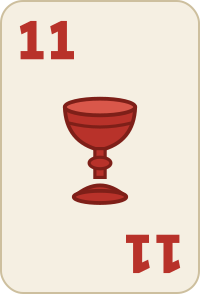
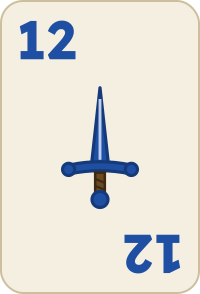
Moroccan players often call the 12 by its Spanish name, el rey (الرّي), and Roonda has a badge with that name for the dealer who captures with a 12 on the last turn.
Why 40 cards?
Spanish decks are usually sold with 40 or 48 cards. The 48-card deck has the 8s and 9s; the 40-card deck leaves them out, and that's the one Ronda uses.
Four suits of ten ranks gives four cards of every rank, and that number shapes the whole game:
- A hit can climb three times at most: there are only four cards of a rank, so the third hit (جوج حبال) can never be answered.
- A Ronda uses two of the four cards of a rank and a Tringa three, so a Tringa leaves a single card of that rank for everyone else.
- Counting is possible: if you've seen three 5s, you know exactly where you stand with the last one.
The deal fits the deck perfectly too:
| Game | Packets in a round | Cards dealt |
|---|---|---|
| 1 vs 1 | 5 packets of 4 | 2 players × 20 = 40 cards |
| 2 vs 2 | packets of 4, 3, 3 | 4 players × 10 = 40 cards |
Every card is played in every round. Nothing stays hidden in a stock, which is exactly why counting pays off. And with 40 cards in all, 20 is a fair split: that's why the team with more cards scores its total minus 20 at the end of the round.
Rank order: 7 comes before 10
The order of the cards is: 1, 2, 3, 4, 5, 6, 7, 10, 11, 12.
Since there's no 8 or 9, the 10 follows straight after the 7 in a run:
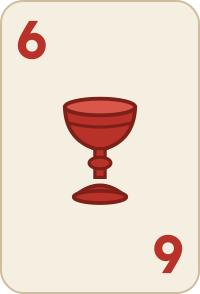
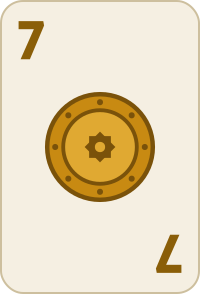
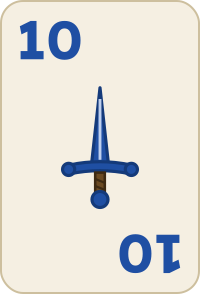
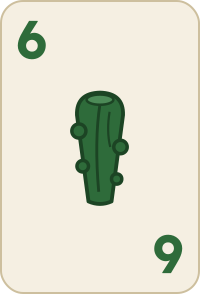
The order stops at 12: a run doesn't loop back to the 1.
Which cards matter most?
No card in Ronda is stronger than another in a capture: a 2 takes a 2 and a 12 takes a 12. But some ranks have a special job.
- The 12 is the best card for the dealer's last turn: a capture with it pays the dealer's team 5 points. It also makes the best Ronda.
- The 1 is the worst card for that same turn: a capture with it gives 5 points to the other team. But three 1s make the best Tringa, because between two Tringas the lower rank wins.
- The 10, 11 and 12 make strong Rondas, because between two Rondas the higher rank wins.
More on this in How Ronda scoring works and Declaring Ronda and Tringa.
Reading a real Spanish deck
If you buy a Spanish deck, two details help.
The frame. Many Spanish decks have a line around each card that breaks in a different way for each suit, so you can see the suit from the edge of the card when your hand is fanned out. The mark is called la pinta. Cups have one break, swords two, clubs three, and coins none.
The numbers. The picture cards usually carry their numbers in the corner: 10, 11 and 12. Some decks also include 8s, 9s and two jokers. Take them out before you play.
Where the deck comes from
Playing cards were in use in Mamluk Egypt by the 14th century, and spread from there to the Iberian peninsula. Spanish still shows it: the word for playing cards, naipes, comes from nā'ib, the name of a face card in the Mamluk deck. In the Crown of Aragon, cards appear in written records from the 1370s and 1380s.
The 40-card deck became popular in the 17th century, with a game called ombre. Today Spanish-suited cards are played across Spain, Latin America and North Africa, and one of the classic Spanish designs is still found today especially in Morocco and Algeria.
No Spanish deck at home?
You can play Ronda with an ordinary 52-card deck. Take out the 8s, 9s and 10s, then use the jack as the 10, the queen as the 11 and the king as the 12. The ace is the 1. That leaves 40 cards, and since suits don't matter in Ronda, the game plays exactly the same.
Or skip the shuffling: Roonda deals the deck for you, with real Spanish suits. Play Ronda online, or start with the full rules.