
Ronda, Scopa, Escoba and Chkobba: four fishing games compared
Card players call them fishing games: you play a card from your hand and use it to "fish" cards out of the middle of the table. Ronda belongs to this family, and so do three games you may have met on holiday or at a friend's house: Scopa in Italy, Escoba in Spain and Chkobba in Tunisia.
If you already know one of them, you'll feel at home in the others within a few hands. But the details change a lot: what a card can capture, what a sweep is worth, and how many points you need to win. This guide puts the four side by side.
The same family of 40 cards
All four games use a 40-card deck: four suits of ten cards, the numbers 1 to 7 plus three picture cards. What changes is the look of the cards and what their numbers are worth.
| Game | Country | Deck | Picture cards count as |
|---|---|---|---|
| Ronda | Morocco | Spanish: coins, cups, swords, clubs | 10, 11, 12 |
| Scopa | Italy | Italian: coins, cups, swords, clubs | 8, 9, 10 |
| Escoba | Spain | Spanish: coins, cups, swords, clubs | 8, 9, 10 |
| Chkobba | Tunisia | usually French: spades, hearts, diamonds, clubs | queen 8, jack 9, king 10 |
In Ronda, the three picture cards are simply ranks 10, 11 and 12, and only their order matters. In the other three games, every card has a value that you add up, and the picture cards are worth 8, 9 and 10. Escoba uses the very same Spanish cards as Ronda, but its sota (Ronda's 10) is worth 8, its caballo (11) is worth 9 and its rey (12) is worth 10. Chkobba has one twist of its own: the queen is worth 8 and the jack 9, the other way round from what most players expect.
New to the Spanish cards? The Spanish deck in Ronda explains the suits and the picture cards.
The deal: an empty table or four cards up
The first difference shows before anyone plays.
Scopa, Escoba and Chkobba deal three cards to each player and lay four cards face up on the table. The rest of the deck waits in a stock. When everyone has played their three cards, each player gets three more, and nothing more goes on the table. Some opening tables are thrown back: Scopa redeals if three or four kings land face up, and Chkobba redeals if three cards of the same rank do. In Escoba, if the four table cards add up to 15, the dealer takes them straight away.
Ronda starts with an empty center. The cards come in packets: five packets of four cards each in a 1 vs 1 game, and packets of 4, 3 and 3 in a 2 vs 2 game. The whole deck is dealt in every round, with no stock left over. That's why counting cards works so well in Ronda: by the last packet you can account for most of the cards.
Captures: same rank, sums, or 15
This is where the four games really split. Here is one table, and the same card played under each rule.
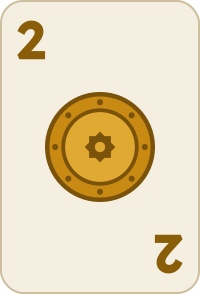
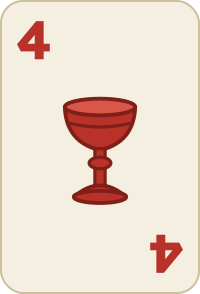
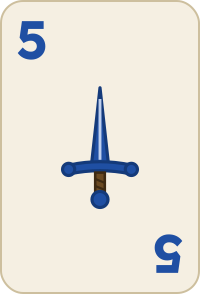
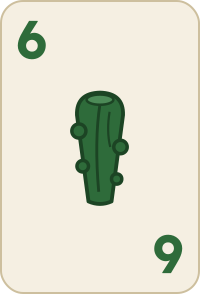
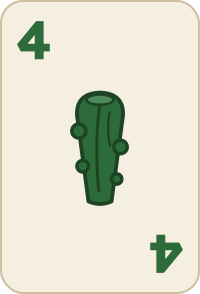
- Ronda: your 4 takes the 4, then the run that climbs from it: 5 and 6. The 2 stays. Ronda captures by rank, and the run upward always comes with it.
- Scopa and Chkobba: a card can take one card of the same value, or several cards that add up to its value. But when a single card matches, you must take that one. So your 4 takes only the 4.
- Escoba: your card plus the cards you take must add up to 15. With a 4 you need 11 from the table: the 5 and 6, or the 2, 4 and 5. You choose one set.
Now a table where nothing matches by rank:
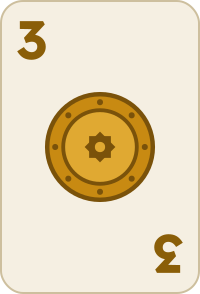
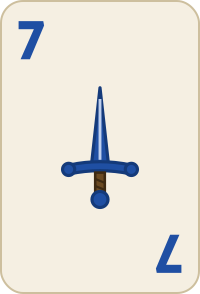
In Scopa and Chkobba, 3 + 4 = 7, so the 7 clears the table. In Escoba, 7 + 3 + 4 makes 14, one short of 15, so the 7 is simply left on the table. In Ronda, there's no adding at all: the 7 matches nothing, so it stays in the center, and the next player may hit it with another 7.
Must you capture when you can? In Ronda, yes: if your card matches a rank in the center, you take it (and its run). Avoiding a capture means playing a card whose rank isn't there. Scopa has a similar rule. For Escoba and Chkobba, written rules disagree on this point, so ask at the table.
Sweeping the table: Scopa, Escoba and Missa
All four games reward the player who takes every card on the table. The words even match: scopa and escoba both mean "broom", and Chkobba is generally described as a Tunisian form of Scopa. In Ronda the sweep is called Missa (ميسا).
| Game | Sweep name | Worth | When it's counted |
|---|---|---|---|
| Ronda | Missa | 1 point | at once (not when your team has 40) |
| Scopa | scopa | 1 point | at the end of the hand |
| Escoba | escoba | 1 point | at the end of the hand |
| Chkobba | chkobba | 1 point | at the end of the hand |
In the three cousins, players usually turn the sweeping card face up in their pile to keep count. Scopa and Chkobba also say that the very last play of the hand can't score a sweep. Ronda has no such exception, but it has two rules of its own: a team on 40 points can't score a Missa, and a Missa made by a hit travels with the hit stack, so the team that banks the stack gets it. More in How Ronda scoring works.
What only Ronda has
Scopa, Escoba and Chkobba are calm, counting games. Ronda adds a layer of table talk and risk that its cousins don't have.
- Hits. Capture the card the previous player just played and you score 1 point. If the next player hits the same rank again, they take the whole stack and score 5; a third hit scores 10. Only the last hit counts. See Ronda hits explained.
- Ronda and Tringa. Two cards of a rank in your hand make a Ronda, three make a Tringa. Declare them before you play any of those cards: each Ronda adds 1 point and each Tringa 5 points to the packet's pool, and the best combination takes the whole pool.
- Spotting. At the end of the packet, the team that won the pool may call out an opponent who held a Ronda or Tringa without declaring it. A correct spot scores, a wrong one costs the same amount. See Declaring Ronda and Tringa.
- The dealer's last capture. On the very last turn of the round, a dealer who captures with a 12 wins 5 points for their team. Capturing with a 1, or not capturing at all, gives 5 points to the other team. See The dealer's last capture.
- Suits don't matter. A 7 of coins is just a 7. In the other three games, the coin (or diamond) suit and its 7 are worth points of their own.
Scoring and winning
At the end of a hand, Scopa, Escoba and Chkobba hand out single points for a short list of prizes. A tie on any prize scores nothing.
| Prize | Scopa | Escoba | Chkobba |
|---|---|---|---|
| Most cards | 1 | 1 | 1 |
| Most coins (diamonds) | 1 | 1 | 1 |
| The 7 of coins (diamonds) | 1 | 1 | 1 |
| Sevens | 1 (primiera) | 1 (most sevens, or a prime) | 1 (most 7s, then most 6s) |
| Each sweep | 1 | 1 | 1 |
Scopa's primiera compares each side's best card in every suit on a special scale where 7 is highest, then 6, then the ace. Some Escoba rules use the same kind of count, others simply give the point for the most sevens. Chkobba calls these prizes karta (cards), dinari (diamonds), barmila (sevens) and sabaa el haya (the 7 of diamonds).
The scores to reach are different too:
- Scopa: usually 11 points; some tables agree on 16, 21 or 31.
- Escoba: 21 points.
- Chkobba: a target agreed before the game, most often 11 or 21 (sometimes 31).
- Ronda: 41 points, and the game stops the moment a team reaches it, even in the middle of a packet.
Ronda's card count works differently as well. Every game gives leftover table cards to the last player who captured. But where the cousins give one point for having more cards, Ronda pays the difference: the team with more cards scores its total minus 20. Take 26 cards in a round and you score 6 card points.
The four games side by side
| Ronda | Scopa | Escoba | Chkobba | |
|---|---|---|---|---|
| Home | Morocco | Italy | Spain | Tunisia |
| Deck | 40 Spanish cards | 40 Italian cards | 40 Spanish cards | 40 cards, usually French |
| Table at the start | empty | 4 cards up | 4 cards up | 4 cards up |
| Cards in hand | packets of 4 (or 4, 3, 3) | 3 at a time | 3 at a time | 3 at a time |
| How you capture | same rank, plus the run upward | same value, or a sum | cards that make 15 | same value, or a sum |
| Sweep | Missa, 1 point | scopa, 1 point | escoba, 1 point | chkobba, 1 point |
| Suits that score | none | coins, 7 of coins | coins, 7 of coins | diamonds, 7 of diamonds |
| Extra scoring | hits, Ronda and Tringa, spots, dealer's 12 | primiera | sevens | sevens |
| Most cards | cards minus 20 | 1 point | 1 point | 1 point |
| Played to | 41 | 11, or as agreed | 21 | agreed: 11, 21 or 31 |
House rules are common in all four. Scopa, Escoba and Chkobba each have regional versions with bonus points or different targets, so check the local rules before you sit down.
Which one will you enjoy?
- You like mental arithmetic: Escoba. Hunting for sets that make 15 keeps you busy every turn.
- You want the classic: Scopa, or Chkobba if you grew up with French-suited cards. Both reward careful play over a full hand, with the coins and the sevens to fight for.
- You like bluffing, risk and fast swings: Ronda. Hits can turn a quiet table into a 10-point turn, a declaration can be a mind game, and every packet can change the score.
If you come to Ronda from one of its cousins, the hardest habit to drop is adding cards up: in Ronda, a 7 never takes a 3 and a 4. Think in ranks and runs instead, and watch the card the last player just put down.
Ready to try? Start with the full Ronda rules, then Ronda strategy and 10 beginner mistakes. Or play Ronda online against bots or friends.