
The history of Ronda in Morocco, from café tables to phones
This guide puts together what is actually known: where the cards come from, which games are its relatives, the oldest written description we could find, and how the game moved online. Where the record is thin, we say so.
A deck that crossed the strait
Ronda is played with the 40-card Spanish deck: coins, cups, swords and clubs, with no 8s or 9s. That deck has a long story of its own, from Mamluk Egypt to Spain, and The Spanish deck in Ronda tells it.
How and when those cards reached Morocco is less clear. Nobody has a date for the first Spanish deck on a Moroccan table. Card historians generally assume that North Africa got its Spanish-suited cards from Spain or France. A French writer in 1908 noted that cards, already known in Moroccan ports, had reached the towns inland during the 1800s. By his time, he wrote, they were very popular, and Moroccans played with the 40-card Spanish deck.
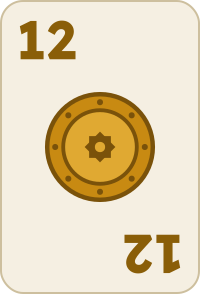
One detail is still visible today. Moroccan decks keep an old Spanish design, the "Spanish National" pattern, which first appeared in Barcelona in the 17th century. Most Spanish-suited countries moved on to newer designs, but this one survives mainly in North Africa, especially in Morocco and Algeria (and also in Ecuador). So the cards on a Moroccan café table look much older than the cards in a shop in Madrid.
One of the fishing games
Ronda belongs to a big family that card players call fishing games: you play a card from your hand to "fish" matching cards out of the middle of the table. Italy's Scopa, Spain's Escoba and Tunisia's Chkobba are in the same family, and Ronda vs Scopa, Escoba and Chkobba compares them in detail.
Ronda's closest relatives, though, are less famous and live across the Atlantic. Two games from the Spanish-speaking Americas share its most unusual features:
| Feature | Ronda (Morocco) | Cuarenta (Ecuador) | Porrazo (Mexico, US) |
|---|---|---|---|
| Capture a run going upward | yes | yes | yes |
| Bonus for taking the card just played | yes, the hit | yes, the caída | yes, the porrazo |
| A call named "ronda" | a pair in hand | three of a rank | a pair in hand |
Card-game researchers describe Porrazo as closely related to Ronda. Nobody has shown how the three games are connected, or which came first. Since they share Spanish cards and Spanish words, a common Spanish ancestor is a natural guess, but it is only a guess: we found no written record that proves it.
The oldest description: 1908
The earliest account of Ronda we know of is a short French article, "Quelques jeux au Maroc" (Some games in Morocco), by Xavier Lecureul. It appeared in the Revue du Monde Musulman in September 1908, and card-game references cite it as an early description of the game.
It is only a paragraph, but it says a lot. According to Lecureul:
- Ronda was known in Spain and played above all in Algeria, but Moroccans played it too, in the cafés.
- Players were very keen on it, and it was not rare to see them play for whole days and nights.
- In cafés, he adds about card games in general, players who weren't playing for money played for their drinks, almost always mint tea.
He also gives a few rules, and they show how much the game has moved since:
| In 1908 | Ronda as played today |
|---|---|
| up to four players | 2 players (1 vs 1) or 4 players (2 vs 2) |
| three cards each | packets of 4 cards (or 4, 3, 3 in a 2 vs 2 game) |
| first to 21 points | first to 41 points |
| "ronda": two cards of the same rank | Ronda: two cards of the same rank, declared |
| "rondel": three cards of the same rank | Tringa: three cards of the same rank, declared |
| kings make the best ronda, aces the worst | the higher pair wins (except when all four declare one) |
The article does not describe hits, Missa, or card points, so we can't tell whether they existed yet or were simply left out. Its picture of Ronda as mainly Algerian is also worth noting. Ronda is still played in Algeria today, but for most people it is now the Moroccan card game. Notice the date, too: in 1908 Ronda was already a café game in Morocco, a few years before the French and Spanish protectorates began in 1912.
Words from Darija and Spanish
Listen to a Moroccan Ronda table and you hear two languages at once. That mix is part of the game's history.
Spanish words. The 12 is often called الرّي (el rey), Spanish for "the king". The word ميسا (missa), for a capture that clears the center, is often linked to the Spanish mesa, "table", since the move leaves the table empty, though nobody can be sure of the path the word took. The call روندا (ronda) is Spanish too, and so is the deck itself. In 1908, Lecureul noted that Moroccans named the cards with Spanish words, except the 5, 6 and 7, which had Arabic names.
Darija words. Most of the action has Darija names. A hit is a ضريبة (daraba), from the Arabic root for striking. The double hit is a حبل (hbel) and the triple a جوج حبال (jouj hbal). To capture is كلا (kla), the center is القاعة (l-qa3a), and the dealer is مول قاعة (moul qa3a). A point is a بونت (bount), and card points at the end of the round are the ماكلة (makla).
Two details stand out. First, the hit has a striking name in two languages: porrazo, the name of the Mexican cousin, means "a blow" in Spanish, and the Moroccan ضريبة comes from a root meaning "to strike". Second, ترينكا (tringa) is a mystery. In 1908 three of a kind was called a "rondel", and nobody seems to know where the word Tringa came from.
The full list, with spellings and meanings, is in the Darija Ronda glossary.
From the café table to the phone
For most of its history, Ronda needed a table and four people in the same room. Phones changed that. Today you can find Ronda in apps and on websites, against the computer or against real people, and the game reaches Moroccans who live far from home and want to play with family or old friends.
Online play changes the game in a few small ways:
- The shuffle is fair. Nobody can be accused of a bad deal.
- The rules are fixed. No more arguing over a tie or a spot: the app applies one rule set.
- The table talk is quieter. You lose the shouting after a حبل, but you can play at 2 a.m. with a cousin in another country.
Why Ronda is still loved
More than a century after that 1908 paragraph, Ronda is still everywhere in Morocco. A few reasons stand out.
- It's quick to learn. Match a rank, take the cards. A child can play after one hand.
- It's deep enough to master. Every card is played in every round, so strong players count all 40. Beginners and experts can sit at the same table, and the expert usually wins.
- It's loud. Hits, double hits and the call of "Ronda!" give the game moments that everyone at the table reacts to.
- It's a team game. In 2 vs 2, you win with a partner, and the post-game argument about who made the mistake is half the fun.
- It costs almost nothing. One deck, a flat surface, and you're set for the evening.
Above all, Ronda is shared. It is a game you learn from someone, and later teach to someone else. That is how it has lasted, and how it will keep going.
Why play Ronda on Roonda
Roonda is Moroccan Ronda on your phone and in your browser.
- Moroccan rules, not a lookalike. Hits worth 1, 5 and 10, declaring Ronda and Tringa yourself, spotting a hidden one, the dealer's last card and the race to 41, all applied the same way every game. The full rules are the ones the app uses.
- Play your way. Against bots on your own (no internet needed), a quick match against people in 1 vs 1 or 2 vs 2, ranked games, or a private room you share with friends by code.
- In your language. English, French and Darija.
- Easy to start. A short tutorial and a first hand with hints, then a bot that's gentle while you learn.
- Free. On iPhone, Android and in the browser.
The café can't be copied, but the game can travel.
Keep learning
New to the game? Start with the full rules, then avoid the classic traps with 10 beginner mistakes. Learn the cards in The Spanish deck in Ronda and the words of the table in the Darija Ronda glossary. To see how Ronda compares with its cousins, read Ronda vs Scopa, Escoba and Chkobba. When you're ready to play better, Ronda strategy and Ronda hits explained are the next steps.
Sources
- Xavier Lecureul, "Quelques jeux au Maroc", Revue du Monde Musulman, vol. 6, no. 9, September 1908, pp. 136 to 142 (scan on the Internet Archive).
- John McLeod, Ronda and Card games in Morocco, Pagat.com.
- Pagat.com, Fishing games.
- The World of Playing Cards, Playing cards in Morocco.
- Wikipedia, Spanish-suited playing cards and Cuarenta.